
Your Goods Have Been Delivered. So Why Is the Invoice Still Unsettled?

A wholesale distributor loads 500 cartons of beverages onto a truck. The warehouse records the dispatch, the driver leaves for the customer’s depot, and the finance team prepares the invoice.
But something happens during delivery.
The customer receives 495 cartons and reports that five arrived damaged. The receiving manager writes the shortage on a paper delivery note, signs it and gives the driver a copy.
The driver continues to the next destination.
Back at the distributor's office, the warehouse record still shows 500 cartons dispatched. Finance has an invoice for 500 cartons, while the customer is preparing to pay for only 495.
Someone now has to find the delivery note, confirm the shortage, contact the warehouse, speak with the driver and correct the invoice.
Until those records agree, the transaction remains difficult to close.
This is a familiar operational challenge in wholesale distribution. The problem is not always the movement of goods itself. It is the gap between what the warehouse records, what the fleet delivers, what the customer accepts and what finance invoices.
For businesses handling large volumes of stock across multiple warehouses and delivery routes, that gap can become expensive.
The solution is to connect the processes.
A warehouse should not operate as an isolated stockroom. A delivery fleet should not be a separate collection of drivers and paper waybills. And the finance department should not have to reconstruct every transaction from documents that arrive days after delivery.
The objective is one connected operational record: from warehouse dispatch to verified delivery and invoice reconciliation.
Why Digital Supply Chain Coordination Is Becoming More Important in Nigeria
Nigeria's logistics environment offers a useful picture of why businesses are moving towards more connected systems. Four developments show how digital records and coordinated processes are becoming part of supply chain operations.
1. Nigeria's National Single Window is bringing trade documentation into one digital process
Nigeria's National Single Window went live on 27 March 2026, creating a central digital platform intended to streamline trade-related documentation and interactions with government agencies.
In November 2026, The Guardian reported that the platform had processed 169,211 licences, permits and other regulatory documents since its launch, with 12,465 importers and agents registered.
Why this matters: Importers and distributors often deal with several organisations before goods reach their warehouses. A more coordinated documentation process can help reduce fragmentation at the trade level. The same principle applies inside a wholesale business: stock, dispatch, delivery and invoicing should not depend on disconnected records.
2. Nigeria's electronic truck call-up system demonstrates the value of organised fleet movement
The Nigerian Ports Authority introduced the Eto electronic truck call-up system to manage truck movement into and out of the Lagos port complexes.
In November 2025, Truck Transit Parks reported that the system had scheduled 3.38 million truck movements since its introduction. The report also discussed the investment required to develop and operate the platform.
Why this matters: Fleet operations involve more than knowing where a vehicle is. They require organised scheduling, movement records and coordination between transport operators and receiving facilities. Wholesale distributors can apply the same operational thinking to their own dispatch and delivery processes.
3. Electronic barriers are strengthening control over port access
In September 2025, the Nigerian Ports Authority introduced electronic barrier systems at terminals within the Lagos Port Complex. The system was integrated with the Eto electronic call-up platform so that access could be controlled using valid call-up tickets.
Why this matters: This is an example of two operational processes working together: truck scheduling and access control. For a distributor, the equivalent is connecting dispatch authorisation with warehouse release records, so goods are not moved without a traceable transaction.
4. Nigeria's public health supply chain is also investing in digital inventory management
In September 2025, the Federal Government announced a digitalised inventory consignment model for essential medicines in federal and national hospitals. The initiative was intended to improve the management and availability of medical supplies.
Why this matters: Inventory visibility is not just a concern for ports and private distributors. It also matters in sectors where stock availability, movement and accountability are critical. Wholesale businesses can draw the same lesson: accurate inventory records must follow goods through the supply chain.
Read the Federal Ministry of Information announcement
These developments do not mean every wholesale distributor needs a port-scale technology investment. They demonstrate a simpler principle: when different parts of an operation share reliable information, it becomes easier to coordinate movement, verify transactions and account for goods.
That is where digital invoicing becomes important.
10 Operational Fixes for Connecting Warehouse, Fleet and Finance
A connected supply chain does not begin with buying more trucks or hiring more administrative staff. It begins with making sure that every movement of goods creates a clear, traceable record.
1. Organise Warehouse Stock by Specific Locations
A warehouse should contain more information than the total quantity of products available.
Staff should be able to identify where each item is stored, how much is available and whether it has already been allocated to an order.
For example, a location code might look like:
WH1-A04-RB-B12
This could represent Warehouse 1, Aisle 04, Rack B, Bin 12.
Where suitable technology is available, barcode labels and scanners can make stock movements easier to record.
Every receipt, transfer, picking activity, return and adjustment should update the relevant inventory record.
The operational benefit: Staff can locate stock more reliably, reduce unnecessary searching and investigate discrepancies using transaction records rather than guesswork.
2. Replace Paper Delivery Notes With Electronic Proof of Delivery

A delivery is not fully documented simply because a truck has left the warehouse.
The business needs evidence of what arrived at the customer's location and what the customer accepted.
An electronic proof-of-delivery process can capture:
Order or delivery reference.
Products and quantities delivered.
Delivery date and time.
Recipient's name and acknowledgement.
Shortages, rejected items or damaged goods.
Supporting photographs where appropriate.
The receiving customer should be able to acknowledge the delivery through a documented process.
The operational benefit: Finance and customer service can refer to a consistent delivery record instead of waiting for physical documents to return with the driver.
3. Record Damaged and Missing Goods Before Closing the Invoice

Consider a delivery of 500 cartons where the customer accepts 495 and rejects five because of damage.
If the receiving team records only the total delivery, the business may struggle to understand why the invoice does not match the customer's records.
Create a process for documenting exceptions at the point of delivery.
The receiving officer should record the affected products, quantities and reason for the discrepancy. Photographs and supporting notes can be included where the system allows.
Finance can then review the accepted and disputed quantities before issuing an adjustment or credit note.
The operational benefit: Disputes are handled with evidence, and the business avoids treating every partial delivery as though the entire order was rejected.
4. Coordinate Fleet Scheduling With Warehouse Preparation
A delivery truck should not arrive at the loading bay while the warehouse is still trying to locate its goods.
Fleet scheduling and warehouse preparation should work from the same dispatch plan.
For each delivery, the business should know:
Which vehicle is assigned.
Which customer or destination is involved.
What products need to be loaded.
When loading should begin.
Whether the goods are ready.
Whether the vehicle has departed.
Where fleet tracking and warehouse systems can be integrated, location information may also help teams prepare for incoming or returning vehicles.
The operational benefit: Warehouse and transport teams can coordinate around a shared schedule rather than depending on repeated phone calls.
5. Give Wholesale Buyers a Structured Ordering Process
Many wholesale businesses still rely heavily on sales representatives to receive routine orders.
A buyer calls, sends a WhatsApp message or emails a list of products. A sales assistant then enters the order into a spreadsheet or business system.
This process may work for a small operation, but it becomes harder to manage as the number of customers and orders increases.
A B2B ordering portal can give approved buyers a structured way to:
Browse available products.
View applicable prices.
Select quantities.
Submit purchase orders.
Review order status.
Access relevant transaction records.
Pricing and purchasing permissions can be managed according to the distributor's commercial arrangements.
The operational benefit: Routine orders enter the business in a more consistent format, reducing unnecessary re-entry and communication delays.
6. Make Delivery Records Verifiable
A paper waybill can be misplaced, damaged or difficult to retrieve. A digital document can make delivery information easier to store and access, but it must still be properly controlled.
Each delivery record should have a unique reference linked to the relevant customer order and dispatch transaction.
Access to edit, approve or correct delivery records should be restricted to authorised users. Changes should be recorded so that the business can identify who made them and when.
Where required, the business can use additional verification methods to strengthen document authenticity.
The operational benefit: Staff can trace a delivery to its supporting records and investigate disputes without relying entirely on physical paperwork.
7. Connect Logistics Records to Finance and Invoicing

This is the centre of the entire workflow.
When goods leave the warehouse, the dispatch record should be linked to the customer order. When the customer receives the goods, the delivery record should be linked to the same transaction.
Finance can then compare:
What the customer ordered.
What the warehouse dispatched.
What the customer received.
What was accepted or disputed.
What should be invoiced.
What has been paid.
Accounting entries and revenue recognition should follow the business's accounting policies and applicable standards; a dispatch or delivery event should not automatically be treated as sufficient evidence for every accounting decision.
The operational benefit: Finance works from traceable transaction information rather than trying to rebuild the story of a delivery from separate documents.
8. Plan Delivery Routes With Better Information
Fuel, vehicle maintenance and delivery delays all affect distribution costs.
Route planning should consider the locations of customers, delivery commitments, vehicle capacity and the number of stops assigned to each truck.
A route-planning tool can help organise delivery sequences and reduce unnecessary movement, especially where several customers are located within the same area.
The business should also monitor actual delivery performance and compare it with planned schedules.
The operational benefit: Better planning gives fleet managers greater visibility over delivery commitments and vehicle utilisation.
9. Set Replenishment Rules for Regional Warehouses
A central warehouse may have enough stock while a regional depot is running out of fast-moving products.
If stock levels are reviewed only when a branch requests replenishment, the business may discover shortages too late.
Establish minimum and maximum stock levels for each location, taking into account sales patterns, replenishment lead times and the importance of each product.
When stock approaches its agreed minimum, the system or responsible staff member can raise a replenishment alert or transfer request.
The operational benefit: Regional stock decisions become more organised, helping distributors respond before avoidable stockouts affect customers.
10. Match Payments to the Correct Customer Invoices
The final step is making sure that the money received can be matched to the right customer and outstanding invoice.
A distributor may receive several transfers in one day. Without clear payment references, finance staff may struggle to identify which buyer made each payment or which invoices should be settled.
Use structured payment references and, where supported by the payment provider and business banking arrangements, customer-specific or invoice-linked payment accounts.
Maintain clear records of:
Invoice number.
Customer account.
Amount due.
Amount received.
Payment date.
Outstanding balance.
Any deductions or credit notes.
Unmatched payments should be reviewed rather than automatically assigned to an invoice.
The operational benefit: The finance team has a clearer view of outstanding receivables and can investigate payment differences more efficiently.
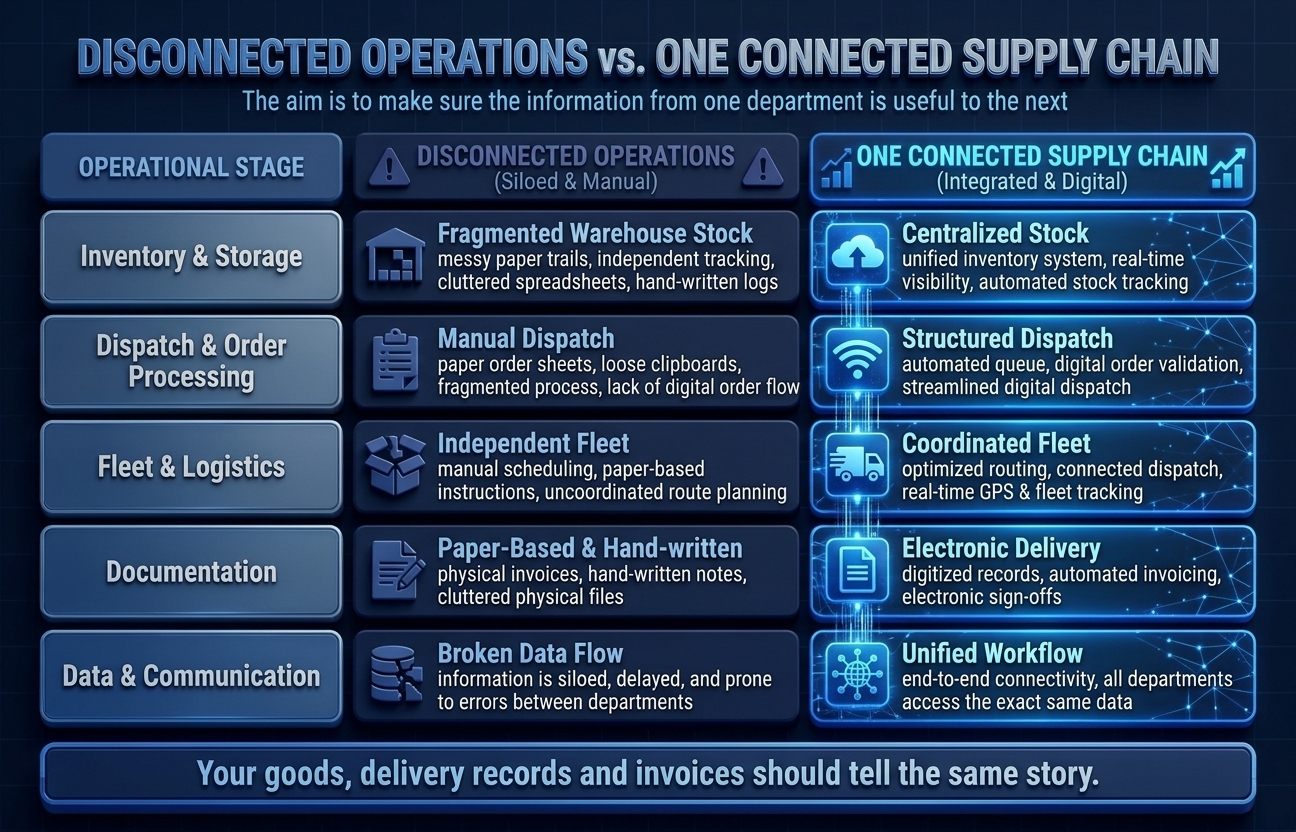
The biggest improvement is not simply replacing paper with screens.
It is ensuring that the warehouse, fleet and finance teams are working from the same transaction history.
How Ofia Supply Chain IMS Fits Into This Vision
For a wholesale distributor, the challenge is rarely limited to one department.
Warehouse staff need to know what is available. Dispatch teams need to know what should leave the facility. Drivers need clear delivery instructions. Customers need accurate records of what they received. Finance needs reliable information to prepare and reconcile invoices.
These responsibilities are connected, even when the departments handling them are not.
Ofia Supply Chain IMS is positioned around the need for more organised supply chain operations, bringing the conversation beyond isolated warehouse spreadsheets and disconnected dispatch records.
The goal is to help businesses manage important operational information in a more coordinated environment.
For distributors considering a system, the important questions are practical:
Can warehouse records be organised across locations?
Can dispatch information be linked to customer orders?
Can delivery records be retrieved when a dispute arises?
Can invoice information be reconciled against delivery outcomes?
Can managers see the information they need without collecting separate reports from every department?
The exact capabilities, integrations and automation available in Ofia should be confirmed against the current product specification before being presented as live functionality. Features such as barcode scanning, mobile electronic proof of delivery, GPS-triggered alerts, automatic credit notes and direct accounting-ledger integration should only be promised where they are actually supported.
Stop Letting Paperwork Separate Your Warehouse From Your Cash Flow
A truck leaving the warehouse is only one part of a wholesale transaction.
The business still needs to know what was loaded, what arrived, what the customer accepted, what was invoiced and what has been paid.
When those records are disconnected, even a successful delivery can become an administrative problem.
But when warehouse, fleet and finance processes are organised around one transaction history, teams have a clearer way to trace goods, resolve discrepancies and manage customer accounts.
The takeaway is simple: your goods, delivery records and invoices should tell the same story.
Take the Next Step With Ofia
If your wholesale operation is still managing warehouse records, dispatch documents and invoicing through separate processes, it may be time to explore a more connected approach.
Visit Ofia waitlist to explore the available solutions and discuss your supply chain requirements.
Build a distribution operation where every movement of goods has a record, every delivery can be accounted for and every invoice has supporting information.